Will We Have Economic Recovery?
April 29, 2020 The coronavirus has put almost all of life on hold. Families, businesses, churches, and governments have crawled to a standstill as communities grapple with the worst pandemic in over a hundred years. States are starting to reopen, all at different rates, and people are starting to ask: what type of economic recovery will we have?
Economists expect one of three different types of economic recovery:
-V-shaped recovery: an economic period in which the economy experiences a sharp decline. However, it is also a brief period of decline. There is a clear bottom (called a trough), which does not last long. Then there is a strong recovery.
-U-shaped recovery: when the decline is more gradual, i.e., less severe. The recovery that follows starts off moderately and then picks up speed. The recovery could last 12-24 months.
-L-shaped recovery: a steep economic decline followed by a long period of no growth. When an economy is an L-shaped recovery, getting back to where it was before the decline will take years.
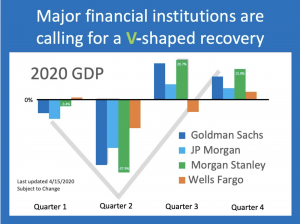 This is a difficult question to answer because there are so many factors to consider. Many top financial services are expecting a V-shaped recovery. Goldman Sachs, Morgan Stanley, Wells Fargo Securities, and JP Morgan have all recently come out with projections that call for GDP to take a dive in Q1 and Q2, but to make a strong comeback the remainder of the year.

Photo by Anna Shvets from Pexels
Certainly not. Some are concerned that even with businesses fully operational, Americans may be reluctant to jump right back in.
Market Business News says:
“In a typical V-shaped recovery, there is a huge shift in economic activity after the downturn and the trough. Growing consumer demand and spending drive the massive shift in economic activity.”
If we see consumer demand and spending slow to return, then we may be headed for a U-shaped recovery.
In a message from Chris Hyzy, Chief Investment Officer for Merrill and Bank of America Private Bank, he agrees that we should expect a revival in the economy later this year:
“We’re forecasting real economic growth of 30% for the U.S. in the 4th quarter of this year and 6.1% in 2021.”
His projections though still call for a U-shaped recovery based on tepid consumer spending:
“After the steep plunge and bottoming out, a ‘U-shaped’ recovery should begin as consumer confidence slowly returns.”